
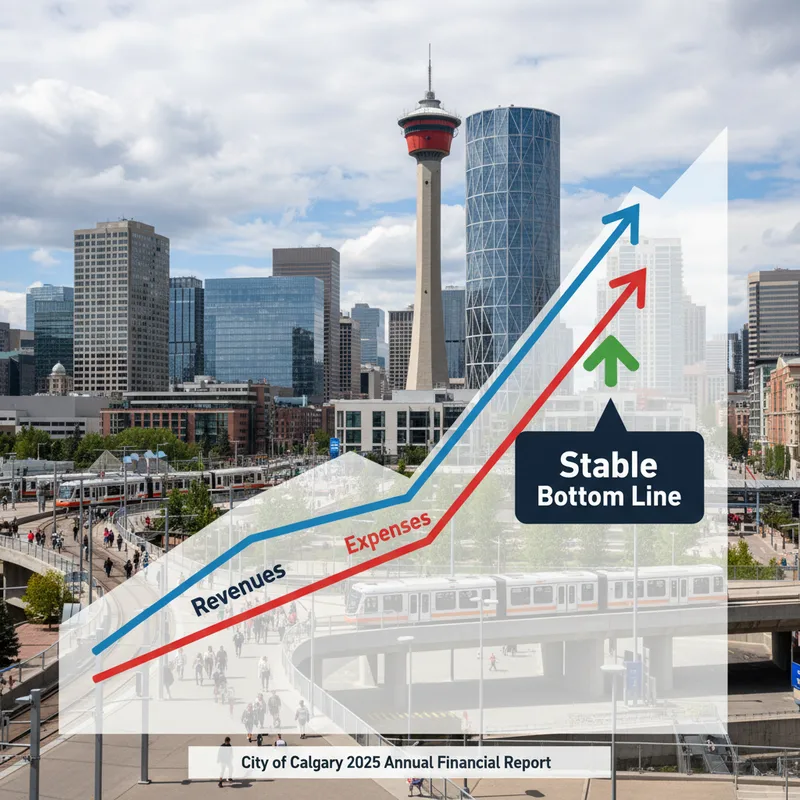
The City of Calgary’s finances are in 'decent shape,' according to the 2025 annual financial report presented to a council committee on Thursday. The report indicates that while the city is facing escalating expenses driven by inflation and population growth, revenues are also increasing at a pace sufficient to maintain a stable fiscal position.
This annual review provides a crucial snapshot of the municipality’s economic health, assuring councillors that Calgary is successfully balancing its books. However, the document also serves as a caution, highlighting the significant financial pressures looming on the horizon, most notably billions of dollars in planned infrastructure projects needed to support the burgeoning city.
The assessment suggests that for now, the city’s financial strategy is holding steady. Strong revenue streams, bolstered by a growing population and a resilient local economy, are covering the rising costs of delivering services to more and more Calgarians. This balance is critical for a city that continues to attract new residents from across Canada and the world.
Balancing the books in a growing city
Calgary's status as one of Canada’s fastest-growing cities is a double-edged sword financially. The continuous influx of new residents, many of whom consult checklists for moving to Calgary, expands the municipal tax base and fuels economic activity, which in turn boosts city revenues from various sources. This growth is a sign of a vibrant, desirable community.
However, a larger population places proportionally greater demands on city services. More people means more demand for public transit, waste and recycling collection, fire and police services, and parks and recreation. These operational costs naturally increase with the population, a fact reflected in the expense side of the city's ledger. Earlier this year, both the Calgary police and fire departments presented their own year-end reports calling for increased funding to keep pace with the city's needs.
While property taxes are the most significant and publicly discussed source of municipal income, they are not the only stream keeping the city afloat. The 2025 report's positive assessment is also supported by other revenue sources, including investment income, franchise fees, and user fees for specific services like transit and recreation. The healthy performance of these combined revenue streams has been essential in offsetting the city's growing operational expenditures.

Billions in future infrastructure costs loom
Perhaps the most significant challenge outlined in the financial report is the monumental cost of future infrastructure projects. While the city’s current operational budget is balanced, officials are acutely aware of the multi-billion dollar capital investments required in the coming years. These are not discretionary expenses but essential projects to ensure Calgary can function effectively as it grows.
These future costs encompass a wide range of projects, from expanding the LRT network to accommodate more commuters, to building new roads, bridges, and interchanges to ease traffic congestion. Significant investment is also needed in less visible, but equally critical, infrastructure like water treatment plants and flood mitigation projects. As new communities are developed, the city must also fund the construction of new libraries, recreation centres, and other public facilities.
Major projects like the continued development of the Green Line LRT and potential future investments in a new event centre or sports facilities represent massive, multi-year financial commitments. Furthermore, the city must also manage the ongoing costs of maintaining its existing assets, which includes not only roads and buildings but also designated heritage sites that require specialized upkeep. The current 'decent shape' of the city's finances provides a stable platform from which to plan, but does not diminish the scale of the spending to come.
The backdrop of tax hikes and policy shifts
The findings of the 2025 financial report do not exist in a vacuum. They are directly connected to recent, and sometimes controversial, decisions made by city council. Most notably, homeowners are facing an 8.1 per cent property tax increase this year, a measure intended to directly bolster the revenue side of the ledger that the report covers. This increase helps fund the very services seeing higher demand and allows the city to begin setting aside funds for the major infrastructure projects on the horizon. In other Canadian cities, similar revenue challenges have led to difficult decisions, such as when Toronto fights Ontario's airport takeover plan. More information about municipal budgets can be found on The City of Calgary's official website.
The city's financial picture is further complicated by the interplay of municipal policy and funding from other levels of government. Council's recent decision to repeal its contentious city-wide rezoning bylaw, for example, has introduced new financial uncertainty. The move has reportedly placed the final instalment of a significant federal housing fund payment 'up in the air,' demonstrating how policy decisions can have immediate and substantial impacts on the city’s bottom line.
Ultimately, the 2025 financial report paints a picture of a city managing its present-day challenges effectively but facing a future that will require disciplined and strategic financial stewardship. The 'decent shape' assessment is a vote of confidence in current management, but the true test will be navigating the immense spending pressures that lie ahead. How council chooses to budget for and finance its ambitious infrastructure plans will determine Calgary's financial health for decades to come.