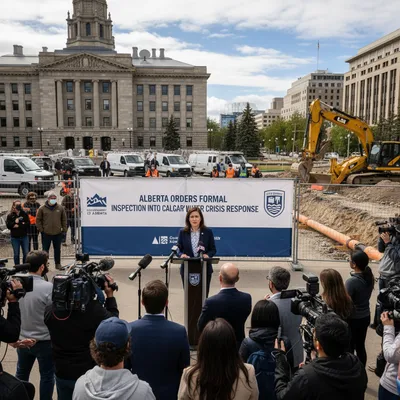
Calgary city council has rejected a proposal to build a new kindergarten to Grade 12 charter school in a northeast industrial park, leaving proponents scrambling and 750 enrolled students without a home for the upcoming school year.
In a 12-2 vote on Tuesday, councillors turned down the rezoning application from the Rocky Mountain Charter School Foundation. The foundation had hoped to repurpose an office building and warehouse space on an 11-acre site in the Deerfoot City Business Park, located near 10 Street and 68 Avenue N.E., between Deerfoot Trail and the Calgary International Airport.
The proposed school was set to have a specialized curriculum focusing on health and wellness, sustainable agriculture, and global technology. However, concerns about the location's suitability for a school proved insurmountable for the majority of council members.
Concerns over industrial location
The proposed site's proximity to heavy industrial operations was a primary point of contention for city council. Several councillors voiced strong objections to placing a school in an area populated by a window and glass manufacturing plant, a heavy equipment storage facility, a drywall supplier, and an ambulance training centre.
The nearby Calgary Police Service firearms training centre also raised significant safety concerns. The industrial nature of the area means a lack of pedestrian infrastructure, such as sidewalks, which was a major red flag for council members evaluating the safety of future students who would be walking in the area.
“I’m not sure why we’re even considering this,” said Ward 10 Coun. Andre Chabot during the council meeting. “This is probably the worst place in the city to put this type of use.”
Mayor Jeromy Farkas echoed these sentiments, stating that placing a school in an industrial park would be 'begging for trouble.' The mayor also voted against the proposal, citing the inadequate pedestrian infrastructure as a key factor in his decision.

A school without a home
The council's decision has left the Rocky Mountain Charter School Foundation in a difficult position. With 750 students already enrolled for the 2026 school year, the foundation now faces the urgent task of finding an alternative location. The rejection of the Deerfoot City site means these students currently have no designated school to attend in the fall.
We don’t have a school for September 2026 for 750 students. It’s not so much a question where we go from here, it’s where the kids go from here.
The situation highlights the challenges alternative education providers face when securing appropriate facilities in a growing city. Charter schools in Alberta are publicly funded but operate with more autonomy than public schools, often offering specialized programs not available elsewhere. This independence, however, does not always extend to ease of finding and zoning suitable properties.
The challenge of finding a site
The search for a suitable school location within Calgary is a complex process, involving zoning laws, land availability, and community acceptance. Industrial areas like the one proposed often have available land and existing buildings that can seem like a cost-effective solution. However, as this case demonstrates, industrial zoning presents significant safety and land-use conflicts that are difficult to overcome. The city's planning department and council must weigh the need for diverse educational options against their responsibility to ensure student safety and appropriate land use. The decision reflects a prioritization of safety over the immediate needs of the charter school's population. For families who had chosen the school for its unique focus, the search for a similar educational environment may be difficult. The situation draws attention to the broader issue of urban planning and how cities accommodate growth and diverse community needs, a topic relevant for many new residents considering urban development challenges, such as when a Wellington school was destroyed in a devastating flood.
While this proposal was rejected, other unique educational and recreational facilities have found success in repurposed urban spaces. For example, a massive indoor bike park is planned near southeast Calgary, showing that innovative uses for industrial-adjacent spaces are possible when safety and zoning align.
The foundation must now restart its search, a process that can take months or even years, leaving the future for its 750 students uncertain. The school will need to find a location that not only meets its educational needs but also satisfies the city's stringent safety and zoning requirements. The government of Alberta provides a list of charter schools across the province, but securing a physical space remains a significant hurdle for new and expanding institutions.