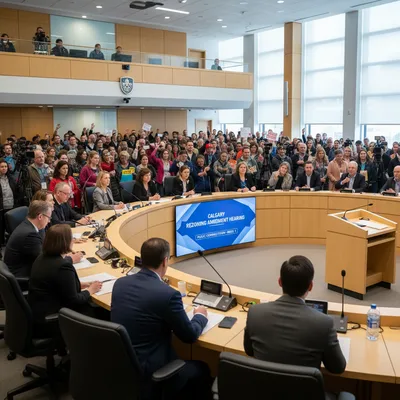
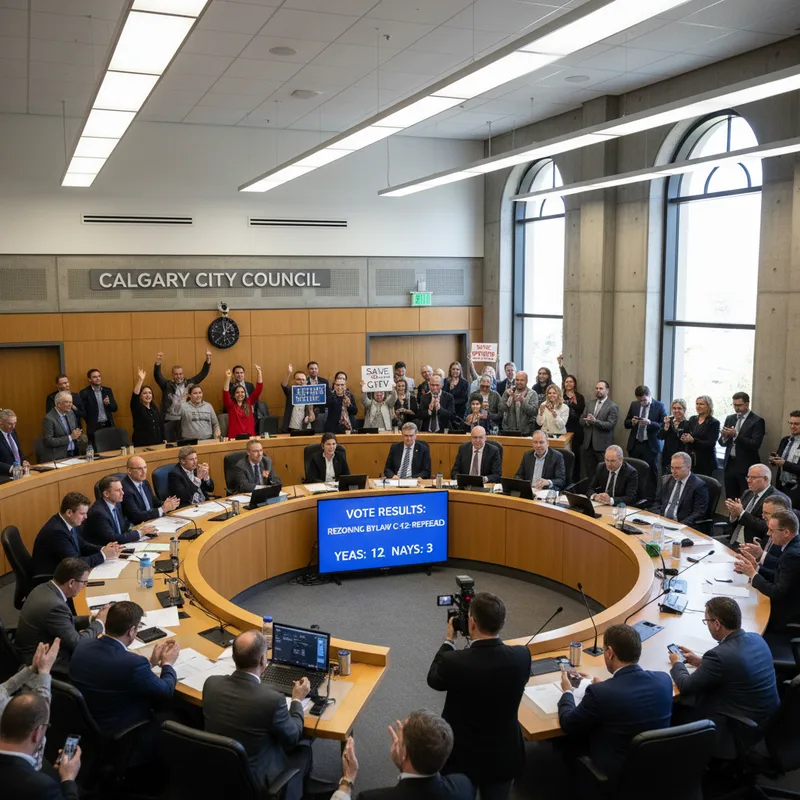
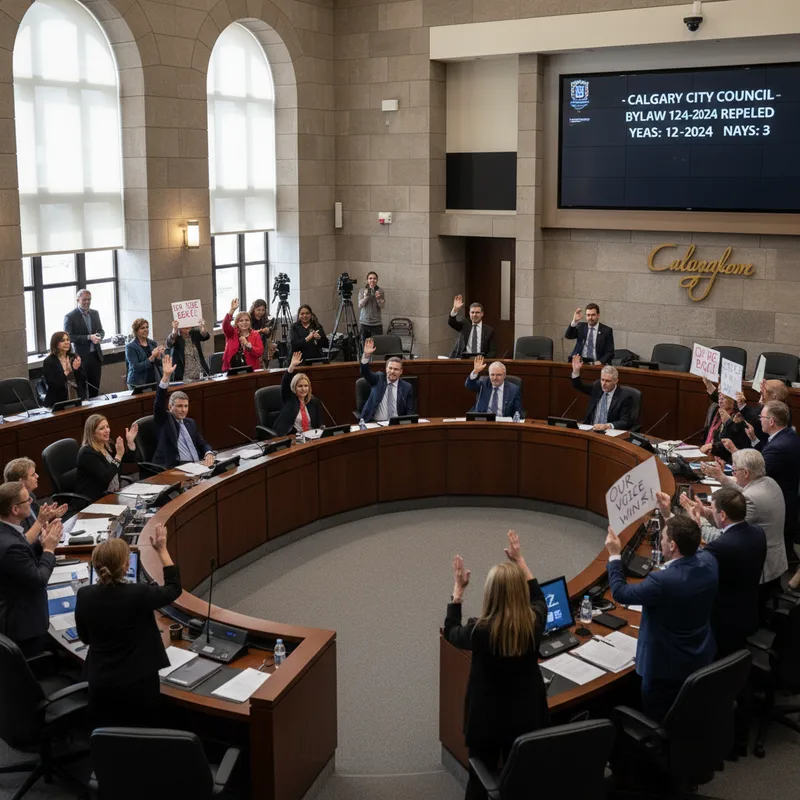
Calgary city council has voted to repeal its divisive citywide rezoning bylaw, unwinding a policy that has reshaped the city's housing debate over the past year. In a 12-3 vote on Wednesday, council approved the repeal, which is set to take effect on Aug. 4.
The vote reverses a policy implemented in August 2024 that made residential grade-oriented infill (R-CG) the default zoning for residential properties. This allowed for the development of denser housing forms like rowhouses and fourplexes on single-family lots without requiring a lengthy public hearing for each project. With the repeal, all affected parcels of land will revert to their previous zoning designations.
Councillors Andrew Yule, Myke Atkinson, and Nathaniel Schmidt were the three dissenting votes against the repeal. The original bylaw was passed after a marathon two-week public hearing in May 2024, which heard from over 730 Calgarians and saw a majority of speakers express opposition.
Since it came into effect, the citywide rezoning policy has enabled the creation of more than 4,500 new housing units, including single-detached, semi-detached, and rowhouses. Of those, approximately 780 are currently under construction.
Relief for critics, but work 'is about to begin'
Opponents of the policy, who argued it removed a crucial avenue for public participation in community development, are welcoming the decision. Robert Lehodey, a member of the group Calgarians for Thoughtful Growth, which had launched a legal challenge against the bylaw, said he was "pleased" with the repeal but stressed that the conversation around housing is far from over.
"It feels good, although I must say, the work is about to begin," Lehodey said, calling the repeal a "first step."
He said the focus must now shift to a more collaborative and targeted approach to development, suggesting a revisit of local area plans. Critics have long maintained that they are not against growth itself but want it managed through better planning and genuine community consultation.
We all want growth, but we want it done thoughtfully, with real input from both the community and planning experts. We really don’t wanna see the fourth floor planning department at City Hall ramming things down people’s throat like they did with the blanket rezoning bylaw.
Ward 13 Coun. Dan McLean, a long-time opponent of the policy, said he was "thrilled" by the outcome. "For it to be reversed to me brings me great joy (and) a lot of satisfaction," he said. "This is what residents wanted, not just mine, but the majority of the city wanted."
Developers warn of investment flight
While critics celebrate, members of the development industry are raising alarms about the uncertainty created by the repeal. Their main concern is not the repeal itself, but the lack of a clear replacement plan, which they say is already causing investment to stall.
Shameer Gaidhar, chair of the Calgary Inner City Builders Association, said his members understand the reasons for the repeal but are worried about the future. "We’re hoping that the replacement does not take too long because if it does, the consequences of that will be detrimental," he said, noting some developers are already looking to shift capital to other cities.
"A lot of developers are saying the risk is too high," Gaidhar stated. He warned that investment is already being redirected to municipalities like Edmonton and Brooks. "You’re seeing capital being dispersed out of Calgary, literally immediately. That’s why the replacement is so important, because once capital moves, it’s not as easy just to bring it back."
The process of securing land use changes on a lot-by-lot basis is expected to add around six months to development timelines. Gaidhar said these delays will inevitably drive up costs, which will be passed on to homebuyers and could impact the availability of certain housing types in some of Calgary's best neighbourhoods.
Fears of rising costs and reduced supply
The primary concern for the building industry is that without a swift replacement, the supply of "missing middle" housing. more affordable options like townhomes and triplexes. will vanish from established communities. Redevelopment in these areas will largely be limited to single-family and semi-detached homes, which are financially out of reach for many Calgarians.
"The preliminary point of view on this is that missing middle housing will remain missing from established areas unless council acts very soon to find a replacement," Gaidhar warned. He predicted broader economic impacts, including job losses in construction, higher rents, and increased home prices due to constrained supply, an issue that may compound for those already concerned about recent property tax hikes.
These concerns echo a report from city administration presented during the public hearing, which warned that a repeal would reduce housing affordability and choice, make it harder for first-time buyers, and add time and uncertainty to housing delivery.
Brian Hahn, CEO of BILD Calgary Region, said the industry is now in a "wait-and-see" mode. "We still are gonna have to reserve a little bit of judgment as to. how much of a step in whatever direction this is," he said. Hahn emphasized the industry’s commitment to working with the city to find a solution that minimizes red tape and costs.
What happens now?
The path forward involves a transition period. According to the City of Calgary, any projects that have already received approval for a development permit, building permit, or subdivision application before the Aug. 4 repeal date will retain their R-CG zoning. However, applications received before that date that have not yet been decided may be subject to the old zoning rules once the repeal is in effect.
Coun. Myke Atkinson, who voted against the repeal, argued that simply scrapping the bylaw does not resolve the core issues some residents had with R-CG developments. "Repealing this does not get rid of R-CG townhomes. It just makes it so that they have to go through a land use change," he said on Wednesday.
Atkinson added that the vote fails to address resident concerns about tree canopy loss, parking shortages, and the scale of densification in their communities. The practical effect is the reintroduction of an additional bureaucratic step, rather than a solution to the design and infrastructure challenges of infill development.
Hahn said the development industry remains focused on balance. "We also recognize that we have to be respectful of the public and public input," he said, noting the goal is to find an approach that is not "one-size-fits-all."